
Expedition Launch: September 2027
* You will be redirected to the secure gateway of our fiscal sponsor, the Players Philanthropy Fund.
Study Design
Study Participants
-
Pre-menopausal women
-
Post-menopausal women
-
High-altitude-adapted (Sherpa)
-
Non-altitude adapted women
Number of Participants
-
30 trekkers
-
20 climbers
Core Shared Dataset
-
Hormones: estrogen, progesterone, testosterone, luteinizing hormone, follicle-stimulating hormone, erythropoietin
-
Basic blood chemistry
-
Acute Mountain Sickness scores
-
Oxygen saturation
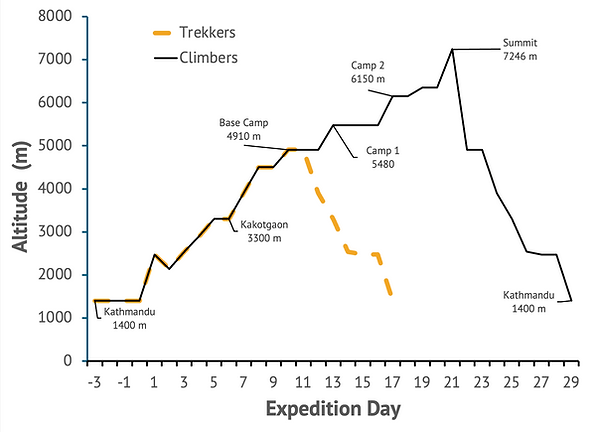
Altitudes of Data Collection
Our Science
Women have been climbing and living at altitude for centuries. The science has never caught up.
In addition to Drs. Tissot van Patot, Keyes and Brodmann, the scientific team includes eighteen lead female scientists from eight countries who designed the seventeen research projects described below.
Funding: Research on women’s health in the mountains receives very little grant funding. Our investigators are applying for the few grants available, but those grants will not cover every study. ISHARE aims to pay for the sample analyses that individual grants do not cover, and donations are what make that possible.
ISHARE also provides what every study shares: expedition logistics, scientific equipment and supplies, power for the equipment, and transport and storage of samples on the trek. The organizers collect a core dataset for all investigators, including hormones, acute mountain sickness scores and basic blood chemistry. Trekkers and climbers pay their own trekking and climbing costs.
Ethics: All studies will receive ethics review and approval before data collection begins.
Investigators and their Studies
Pulmonary Pressure and Brain Blood Flow
Principal Investigator: Lauren Maier, MSc
Center for Heart, Lung and Vascular Health, University of British Columbia – Okanagan, Canada
This study will determine blood flow to the lungs and brain in relation to iron status.
Exercise Capacity
Principal Investigator: Christina Buchanan, PhD
Applied Exercise Science and Performance, Western Colorado University, Gunnison, CO, USA
This study will measure exercise capacity by performing exercise testing at various altitudes.
Behavioral Monitoring of Mental Status
Principal Investigator: Mireia Vicente Mora, MD
Institute of Mountain Emergency Medicine, Eurac Research, Italy
This study will evaluate how participants think, feel, speak and behave during a high-altitude expedition.
Genetics and Metabolism
Principal Investigator: Tanna Wuren, MD, PhD
Research Center for High Altitude Medicine, Qinghai University, China
This study will investigate how genetic variation relates to metabolic changes during acclimatization to high altitudes.
Cognitive Resilience and Risk Assessment
Principal Investigator: Stephanie Lareau, MD
Virginia Tech Carilion School of Medicine, Roanoke, VA, USA
This study will measure attention, decision-making, and the ability to respond safely in challenging situations.
Vasoconstriction
Principal Investigator: Lea Dümpelmann, MD, MGH Institute of Mountain Emergency Medicine, Eurac Research, Italy
This study examines peripheral blood flow in relation to altitude and cold.
Psychological Hibernation
Principal Investigator: Lea Dümpelmann, MD, MGH Institute of Mountain Emergency Medicine, Eurac Research, Italy
This study will investigate psychological hibernation: reduced motivation, emotional withdrawal, fatigue and simplified coping.
Predicting Acute Mountain Sickness
Principal Investigator: Kelsey Elizabeth Joyce, PhD School of Sport, Exercise and Rehabilitation Sciences, University of Birmingham, UK
This study aims to determine if overnight pulse oximetry can predict acute mountain sickness.
Pulmonary Function & Gas Exchange
Principal Investigator: Katie Zugic, MD
Department of Emergency Medicine, University of British Columbia, Canada
This project will investigate how women's lungs and pulmonary blood vessels respond to a reduced-oxygen environment.
Microvascular Response and Adaptation
Principal Investigators: Anne-Aylin Sigg, MD, Rea Andermatt, MD, University Hospital Zurich Anna Zimmermann, MD, University Hospital Bern, Switzerland
This study investigates the adaptation of the microcirculation in pre- and postmenopausal women at high-altitude by using sublingual microscopy.
Peripheral to Core Thermoregulation
This study will measure core-to-peripheral skin temperature gradients. Thermal recovery and rewarming are also measured.
Cognitive & Optic Nerve Sheath Assessment
Principal Investigator: Marika Falla, MD, PhD
Institute of Mountain Emergency Medicine, Eurac Research, Italy
This study will assess cognitive performance and the optic nerve sheath to understand how extreme environmental stressors affect women's cognition.
Sleep and Ventilatory Instability
The study will test whether reproductive stage or adaptation influences nocturnal ventilatory instability and hypoxic burden.
Iron Regulation
This study will evaluate a comprehensive panel of factors involved in iron metabolism, which is vital for the response to hypoxia.
Subclinical High Altitude Pulmonary Oedema
This study will use lung ultrasound to detect subclinical high altitude pulmonary oedema (HAPE) and determine its incidence rate.
Retinal Microvascular Responses
This study will use a portable camera to track tiny blood vessel changes in women at high altitude and see how menopause affects that response.
Women's Perceptions of Acclimatization
Principal Investigator: Silviya Chaulagain, MSc
ISHARE Organizer, Kathmandu, Nepal, Shalynn Howard, MPH, University of Washington School of Medicine
This study will explore how women experience and manage bodily and reproductive health changes at high altitude across life stages.
The three lead organizers steering this expedition's research and logistics.
Three highly accomplished climbing guides will lead us up Putha Hiunchuli.
See the ways to give →
$500 supports a junior Nepali scientist's salary for the expedition. $6,000 funds a portable point-of-care blood analysis machine.